



What Is a Scope of Work?
A scope of work in project management is a formal document that defines the specific tasks, deliverables, timelines and responsibilities required to complete a project. It establishes clear boundaries by outlining what is included and excluded, setting expectations for performance standards, acceptance criteria and work requirements.
The scope of work supports project planning, scheduling, budgeting and monitoring and reduces ambiguity between stakeholders and provides a contractual reference for managing changes, tracking progress and preventing scope creep throughout execution.

Get your free
Scope of Work Template
Use this free Scope of Work Template to manage your projects better.
Get the template
What Is the Purpose of a Scope of Work?
The purpose of a scope of work (SOW) is to clearly define what a project will deliver, how the work will be performed and where responsibilities begin and end. It serves as a shared reference point for all stakeholders, helping align expectations before work starts and reducing the risk of misunderstandings later in the project. By documenting deliverables, timelines, assumptions and constraints, a scope of work creates transparency and supports more accurate planning, budgeting and scheduling.
A well-written SOW also functions as a control tool throughout execution. When questions arise or changes are requested, teams can refer back to the scope of work to determine whether the request is in or out of scope. This helps prevent scope creep, protects resources and supports objective decision-making. Ultimately, the scope of work provides structure and accountability, enabling teams to execute confidently and stakeholders to measure progress against agreed-upon criteria.
A scope of work is designed to:
- Define project deliverables and boundaries
- Clarify roles, responsibilities and expectations
- Establish timelines, milestones and assumptions
- Reduce risk, disputes and unplanned changes
When to Use a Scope of Work
A scope of work should be used whenever a project requires clear expectations, defined deliverables and accountability between parties. It’s especially important at the start of a project, before execution begins, to ensure everyone understands what work is included and how success will be measured. Projects involving multiple stakeholders, external vendors or complex deliverables benefit most from a scope of work, as it reduces ambiguity and supports smoother collaboration.
A scope of work is also critical when projects have fixed budgets, tight timelines or regulatory requirements, where changes can quickly increase risk and cost. Additionally, it should be created or updated when significant changes are introduced, such as revised objectives or expanded requirements. In these situations, a scope of work provides a documented baseline that helps teams manage change, prevent scope creep and maintain control throughout the project lifecycle.
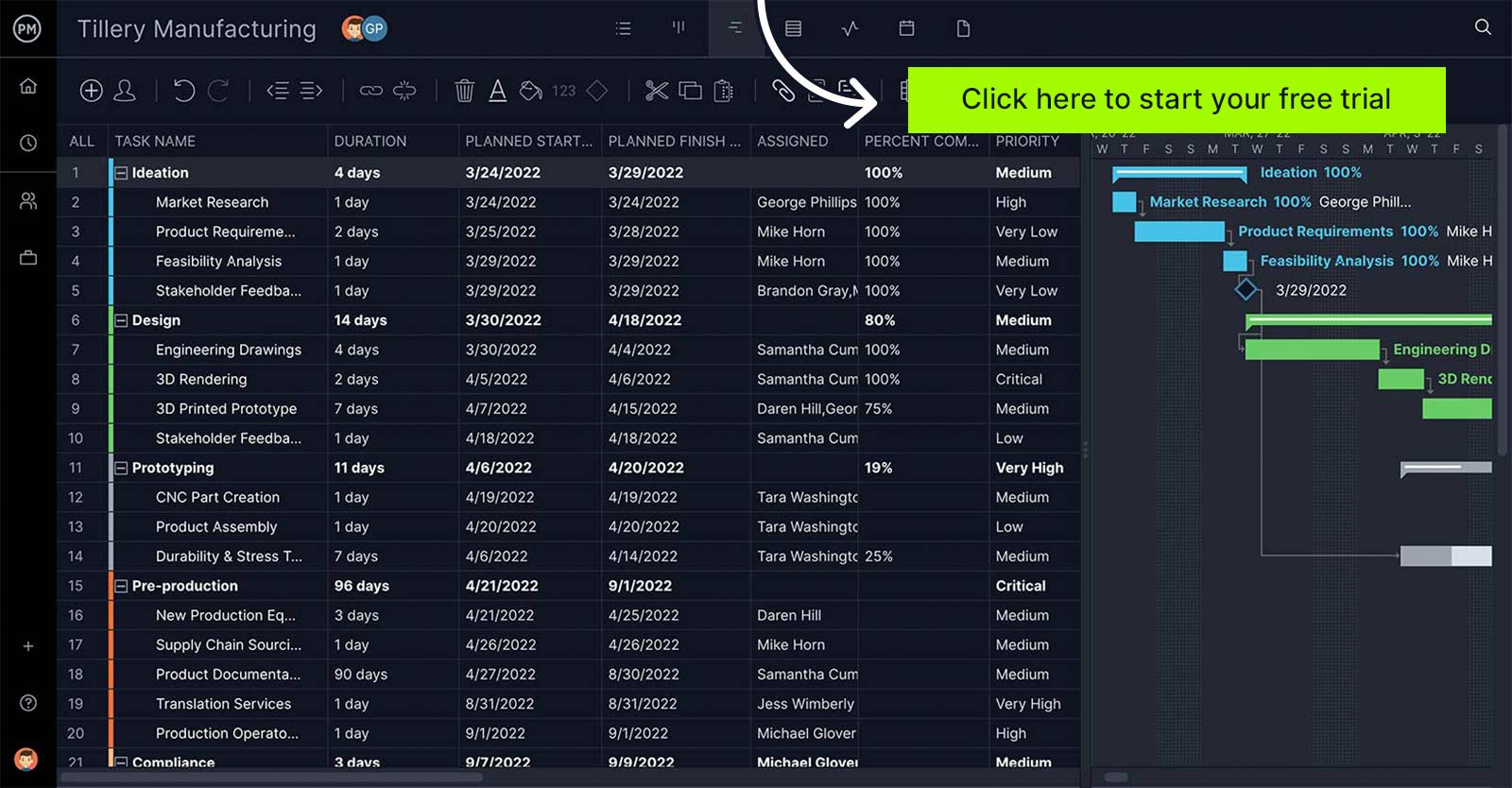
With ProjectManager, make a WBS, design reports and build a project timeline in seconds with our online Gantt chart maker. Map your scope of work, create a budget, assign tasks, add dependencies and more. Then present to your team and stakeholders to get the project moving on the right foot. Try it free today.
What Should Be Included in a Scope of Work Document?
Below is an overview of the main components of a scope of work. You can add or remove some of these elements to better adjust to your project stakeholders’ requirements.
Project Background
Project background provides context by outlining the reasons a project exists, the problem it aims to solve and any relevant history or business drivers influencing the work. In a scope of work document, this section establishes a shared understanding of purpose, helping stakeholders align on objectives, assumptions and constraints before defining deliverables, timelines and responsibilities.
Purpose Statement
A purpose statement clearly describes why a project is being undertaken and what it aims to achieve. In a scope of work document, the purpose statement sets the foundation for all project activities by aligning stakeholders on objectives, guiding decision-making and framing the expected outcomes. It ensures that deliverables, timelines, and responsibilities are connected to the project’s overall goal, providing clarity and direction throughout execution.
Roles & Responsibilities
This section defines the primary participants involved in delivering the work described in the scope of work and clarifies their respective responsibilities. Clearly assigning responsibilities helps prevent gaps, overlaps and misunderstandings during execution and establishes accountability for decision-making, approvals and deliverable acceptance throughout the project.
Client
- Defines business objectives and success criteria
- Provides timely approvals and decisions
- Supplies required inputs, data and access
- Reviews and accepts deliverables
- Identifies a primary point of contact and escalation authority
Project Manager
- Plans and coordinates the work within the defined scope
- Manages task sequencing and dependencies at a high level
- Tracks progress against milestones and timeline
- Coordinates communication and reporting
- Escalates issues, risks and scope impacts as needed
Project Team/Delivery Team
- Executes assigned tasks and work packages
- Produces project deliverables in accordance with quality standards
- Provides status updates and technical input
- Supports reviews, revisions and rework if required
Stakeholders
- Provide input, feedback or approvals as defined
- Participate in reviews and milestone checkpoints
- Support alignment with business, operational or regulatory needs
Work Breakdown Structure (WBS)
A work breakdown structure (WBS) is a hierarchical decomposition of the total project scope into work streams, deliverables, subdeliverables and work packages. It organizes what work is included, not how it is scheduled.
In a scope of work, a WBS is important because it clarifies scope boundaries, aligns tasks to deliverables, reduces ambiguity, supports cost and schedule estimation and provides a common reference for acceptance, change control and contractual accountability across stakeholders, suppliers and project teams throughout delivery and governance processes globally.
Resource Requirements
Resource requirements identify the personnel, skills, tools, equipment, facilities and other assets needed to complete a project successfully. In a scope of work document, detailing these requirements ensures that the right labor categories and skill sets are assigned, necessary tools and equipment are available and any site or facility access is secured. It also clarifies which resources the client will provide, helping prevent delays and supporting smooth project execution.
ProjectManager has robust resource management features that allow organizations to allocate project resources, monitor their utilization rate and track costs in real-time project dashboards and reports. Get started today for free.

Project Deliverables
This is what your project delivers. Whether it’s a product or a service, it’s the reason you’re executing the project for your customer, stakeholder or sponsor. Whatever that deliverable is, and it can be some sort of document or report, software, product, build (or all of the above), you need to clearly identify each item here.
Project Milestones
A task list with dependencies identifies all project activities and illustrates the relationships and sequence between them. Within a scope of work document, it provides clarity on workflow, highlights critical steps, and flags potential bottlenecks. Showing how tasks rely on one another helps stakeholders understand timelines, assign responsibilities effectively and anticipate how delays in one area could affect overall project delivery.
Related: 38 Free Excel Templates for Business (Plus 10 Word Templates)
Project Constraints
Project constraints are the limitations or restrictions that affect how a project is planned and executed, such as budget, timeline, resources, or regulatory requirements. In a scope of work document, outlining these constraints helps set realistic expectations and guides decision-making. Identifying these limits allows stakeholders to plan effectively, manage risks and keep the project achievable within its established boundaries.
Project Assumptions
Project assumptions are conditions or factors considered true for planning purposes, even though they may not be fully verified, such as resource availability, technology reliability or stakeholder support. In a scope of work document, documenting assumptions helps set expectations and provides context for decisions.
They guide planning, highlight potential risks and serve as a reference point if conditions change, ensuring that project deliverables, timelines and responsibilities remain realistic and achievable.
Project Exclusions
Project exclusions are specific tasks, deliverables or responsibilities that are intentionally not included in a project. In a scope of work document, clearly stating exclusions helps prevent misunderstandings and sets boundaries for what the project will and will not cover. By defining what is out of scope, stakeholders can focus on agreed-upon objectives, reduce the risk of scope creep and maintain clarity around responsibilities and project expectations.
Acceptance Criteria
Acceptance criteria are the defined standards a project’s deliverables must meet to be considered complete and satisfactory. In a scope of work document, they outline the acceptance standards, specify the review and approval process, identify the acceptance authority, and set expectations for any required rework. Additionally, acceptance timelines clarify when deliverables must be evaluated. Together, these elements ensure that stakeholders have a clear, shared understanding of what constitutes successful project completion.
Project Timeline
Think of a timeline as a road leading from the start of a project to its end. It’s a section of the document that delineates the major phases across the schedule of the project’s duration. It should also mark the points in the project when your deliverables are ready. As you can guess, it’s essential to scope out the overall plan of any project. This is best presented visually, like a rolled-up Gantt chart plan, so the stakeholders can see the high-level timeline.
Project Milestones
Projects can be long and complex, which is why they’re laid out over a timeline and broken down into more manageable parts called tasks. Larger phases of the project are marked by what’s called a milestone. It’s a way to help you monitor the progress of the project to ensure it’s adhering to your planned schedule. Define your key milestones on a timeline in the scope of work document, including project kickoffs, meetings, hand-offs, etc.
Project Reports
You’ll be generating reports throughout the project, delivered to either your team or customer, stakeholder or sponsor. These can include status reports, progress reports, variance reports and more. They’re a formal record of the progress of your project, but they’re also a means of communication beyond whether the project’s on schedule or not.
Depending on how you customize reports, there’s a wealth of data that can serve a number of different audiences. Define how you’ll be reporting on the project and when the stakeholders can expect them and from whom.
Related: 12 Free Action Plan Templates for Excel and Word
Scope of Work Template
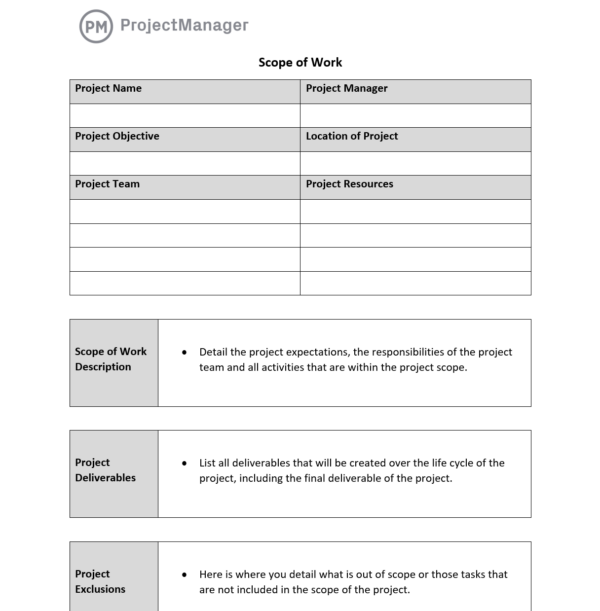
Now that you know what’s included in this all-important document, download our free scope of work template for Word. It has everything you need to make a scope of work document for your own project, so your stakeholders know exactly what to expect in terms of schedule, deliverables and effort.
How to Write a Scope of Work
Now that we’ve listed the elements of a scope of work document, let’s go through the step-by-step process of writing one. These steps can help you create a scope of work for different industries such as construction or manufacturing.
- Define the project goals: Before writing a scope of work, you should define what project goals will be accomplished through the execution of the project tasks that will be included in your scope of work.
- Use a work breakdown structure to identify project tasks: The first step when writing a scope of work is to identify all your project tasks. This is done by using a work breakdown structure (WBS), a project management tool that lets you break down projects and work packages into individual tasks, so you can better plan and schedule them.
- Determine your project deliverables: A project deliverable is a tangible or intangible output from tasks. They’re an important part of a scope of work as they’re the outcomes of the project.
- Establish acceptance criteria for your project deliverables: Project deliverables must meet the acceptance criteria established by the project client, such as quality standards or functionality requirements.
- Use the CPM method to create a project timeline: The critical path method is a project scheduling technique that allows project managers to create a project timeline and estimate project duration by identifying the longest sequence of tasks. It’s important that you use this or other project scheduling techniques to create a realistic schedule for your scope of work.
- Establish payment terms for the project: You may include payment terms as a section of your scope of work.
- Establish project reporting procedures: Effective communication between the project team and stakeholders is crucial, so your scope of work document should include a section that outlines how reporting will be conducted.
Scope of Work Example
This scope of work defines the specific construction activities, deliverables and boundaries for a municipal streetscape improvement project. It details the work required to upgrade pedestrian infrastructure, utilities and public amenities along a designated urban corridor.
Project Background
The city has identified deteriorating sidewalks, inadequate drainage and outdated street lighting along a high-traffic commercial corridor. These conditions present safety risks to pedestrians and limit accessibility. The project involves rehabilitating public right-of-way infrastructure to improve walkability, accessibility and stormwater management while maintaining traffic flow and business access during construction.
Purpose Statement
The purpose of this scope of work is to clearly define the construction tasks, deliverables and execution boundaries required to complete the streetscape improvement project. The purpose statement document establishes a shared understanding of what work is included, how it will be structured and what constitutes completion, serving as the basis for coordination, measurement and change management.
Work Breakdown Structure
The work breakdown structure organizes the total scope of work into manageable components and work packages. It provides a structured view of all construction activities required to deliver the project, supporting planning, coordination and progress tracking.
| WBS ID | Work Package | Description of Work | Primary Deliverable | Responsible Party |
| 1.0 | Mobilization and traffic control | Set up site access, signage and temporary traffic control measures | Approved traffic control setup | General contractor |
| 2.0 | Demolition and removals | Remove existing sidewalks, curbs and damaged pavement | Cleared work zones | Civil subcontractor |
| 3.0 | Stormwater improvements | Install drainage inlets, piping and grading for runoff control | Operational drainage system | Utility subcontractor |
| 4.0 | Sidewalk and curb construction | Form, pour and finish new sidewalks and curbs | Completed pedestrian pathways | Concrete subcontractor |
| 5.0 | Street lighting installation | Install new light poles, wiring and fixtures | Operational street lighting | Electrical subcontractor |
| 6.0 | Final restoration and cleanup | Restore disturbed areas and remove temporary controls | Clean and restored streetscape | General contractor |
Task List With Dependencies
This task list breaks down the work packages into executable tasks and identifies key dependencies that govern sequencing. Dependencies reflect regulatory approvals, physical readiness and coordination requirements that must be satisfied before subsequent tasks can begin.
| Task ID | Task Description | Dependency | Output | Responsible Party |
| T-01 | Install traffic control measures | Approved traffic control plan | Active work zone | General contractor |
| T-02 | Remove existing sidewalks and curbs | Traffic control in place | Demolished surfaces | Civil subcontractor |
| T-03 | Install stormwater infrastructure | Demolition complete | Installed drainage system | Utility subcontractor |
| T-04 | Construct new sidewalks and curbs | Stormwater installation approved | Finished concrete surfaces | Concrete subcontractor |
| T-05 | Install street lighting | Sidewalk construction complete | Operational lighting system | Electrical subcontractor |
Project Milestones
Project milestones represent significant progress points used to track advancement and coordinate inspections, approvals and stakeholder communication throughout execution.
| Milestone ID | Milestone Description | Planned Date | Approval Authority |
| M-01 | Traffic control established | 10/06/2025 | City transportation department |
| M-02 | Demolition complete | 25/06/2025 | Project manager |
| M-03 | Sidewalk construction complete | 20/07/2025 | City inspector |
| M-04 | Final streetscape acceptance | 05/08/2025 | Municipal public works department |
Project Constraints
Project constraints define the fixed limitations that restrict how the work described in this scope of work can be executed. These constraints establish non-negotiable conditions related to schedule, operations, regulatory requirements and the project environment. All work must be planned and performed within these limitations.
| Constraint Type | Description | Impact on Work | Management Approach |
| Operational | Businesses along the corridor must remain accessible during construction | Phased work and limited closures | Maintain pedestrian access and clear signage |
| Regulatory | Work must comply with municipal standards and permit conditions | Restricted construction methods and sequencing | Ongoing coordination with city authorities |
| Schedule | Construction is limited to approved working hours | Reduced daily productivity windows | Detailed daily planning and task batching |
| Environmental | Weather conditions may affect outdoor construction activities | Potential delays to concrete and utility work | Schedule buffers and resequencing |

Project Acceptance Criteria
Acceptance criteria define the conditions that must be met for the completed work to be considered acceptable. These criteria provide objective measures for inspection, approval and formal handover.
| Deliverable | Acceptance Standard | Verification Method | Accepting Authority |
| Sidewalks and curbs | Meets city design and accessibility standards | Field inspection | City inspector |
| Stormwater system | Fully functional with no drainage issues | Operational testing | Public works department |
| Street lighting | All fixtures operational and compliant | Electrical inspection | Electrical authority |
Resource Requirements
Resource requirements identify the labor, equipment and materials necessary to complete the defined scope of work. These resources support planning, coordination and availability management.
| Resource Type | Description | Quantity / Level | Provided By |
| Labor | Construction crews and supervisors | As required by phase | General contractor |
| Equipment | Excavators, concrete mixers, lifts | Project duration | Contractor |
| Materials | Concrete, piping, lighting fixtures | Per specifications | Contractor |
Project Timeline
The project timeline summarizes the planned start and end dates for major phases of work. Dates are indicative and subject to adjustment based on field conditions and approvals.
| Project Phase | Start Date | End Date | Duration |
| Mobilization and demolition | 05/06/2025 | 25/06/2025 | 3 weeks |
| Stormwater and utilities | 26/06/2025 | 10/07/2025 | 2 weeks |
| Sidewalks and lighting | 11/07/2025 | 30/07/2025 | 3 weeks |
| Final restoration and closeout | 31/07/2025 | 05/08/2025 | 1 week |
Why Is It Important to Write a Scope of Work?
Here are some of the reasons why writing a scope of work is beneficial for projects.
Defines the Project Scope
The main purpose of a scope of work is to define the scope of a project. This means defining the work that’ll be done as well as project exclusions, activities or deliverables which aren’t part of a project.
Prevents Scope Creep
Scope creep is a risk that can affect any project. It occurs when additional project tasks are added to the initial project scope during the execution of a project.
These unplanned additions of tasks to the work plan cause extra costs and derail the project schedule. Scope creep can be avoided by having a clear scope of work that establishes what will and what won’t be executed. However, changes might be made to the project scope by using a change request, another important project management document.
Sets Clear Expectations for Project Stakeholders
Without a scope of work document, project stakeholders might have unrealistic expectations about a project, such as assuming certain tasks and deliverables will be done. Therefore, it’s important for project managers and project teams to make sure there’s a scope of work that lets stakeholders know what to expect.
For example, a scope of work is an important element of a project proposal, which is one of the project management documents that allow project management teams to explain stakeholders such as clients or project sponsors what they can expect from a project.
Related: Project Proposal Template
How to Manage Your Scope of Work With Project Management Software
It can feel overwhelming with so many tasks to keep track of, but project management software can simplify the process. In ProjectManager, you can import your spreadsheet or use one of our industry-specific templates to get you started.
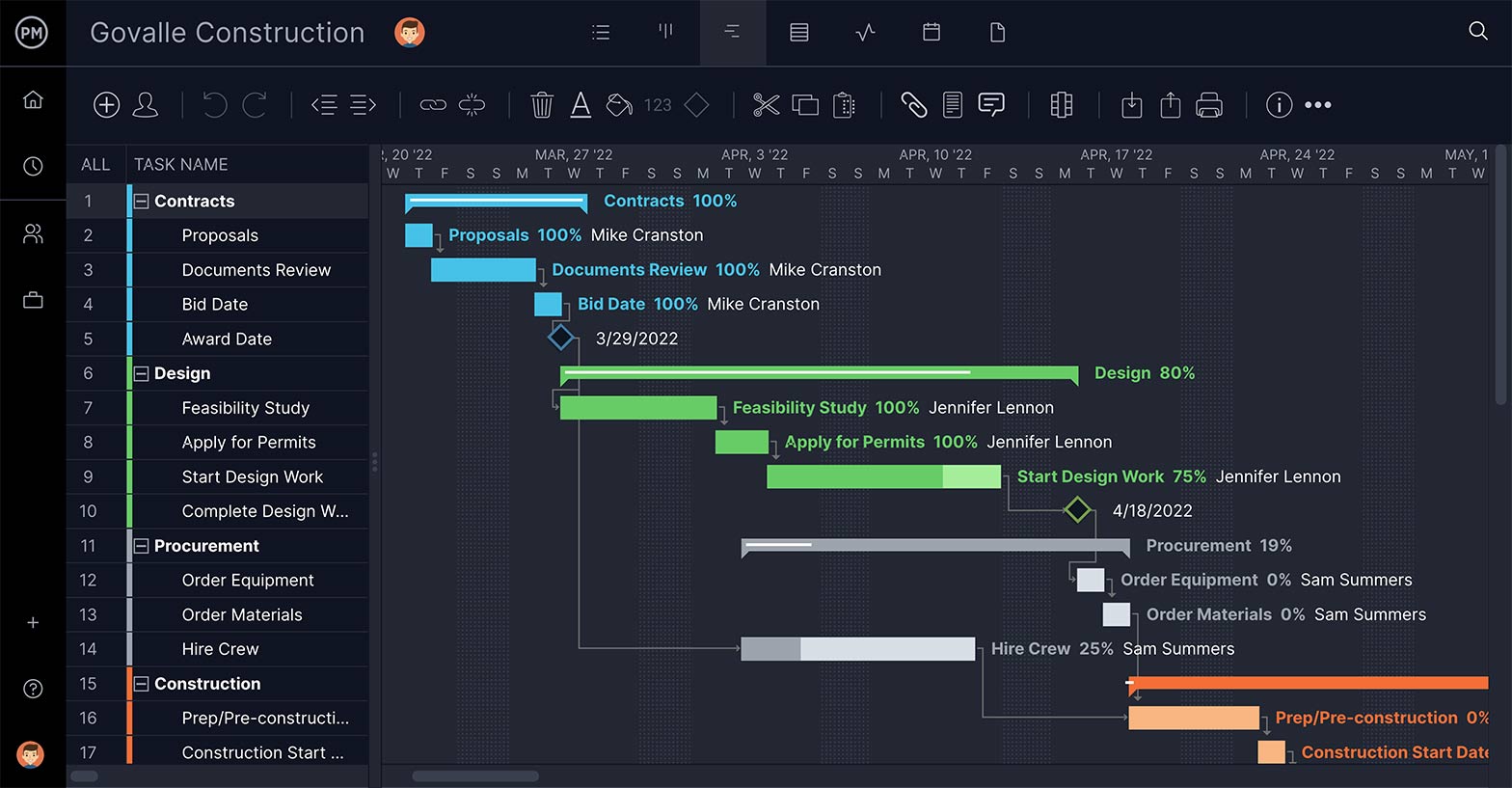
A list of tasks is only a start. To bring order to that chaos, you’ll want to estimate duration by adding start and finish dates. We then automatically put your tasks on a timeline in our Gantt chart project view, so you can see the whole project in one place. Further rein in the tasks by prioritizing them, linking dependencies to prevent bottlenecks later in the project and setting milestones to break up the larger project into more manageable phases.
Collaborate at the Task Level
Tasks need people to execute them and move your project forward. You have your schedule, so onboard your team and start assigning them tasks. You can do this from any of our multiple project views. We offer collaborative tools that make teams more productive and help them work together. You can direct them with task descriptions and by attaching files to the task. Then, they can work together, commenting at the task level with other team members, who are notified by email. This is great for remote teams and even those working in the same room.

Track Progress to Stay On Time and Under Budget
Speaking of distributed teams, how can you keep track of their progress if you can’t check in on them? We solve that problem with great monitoring features, such as a real-time dashboard that shows you task progress, costs and other high-level views of the project. Our software takes status updates and automatically displays them in easy-to-read charts and graphs. You can even share them at stakeholder meetings to keep them in the loop.
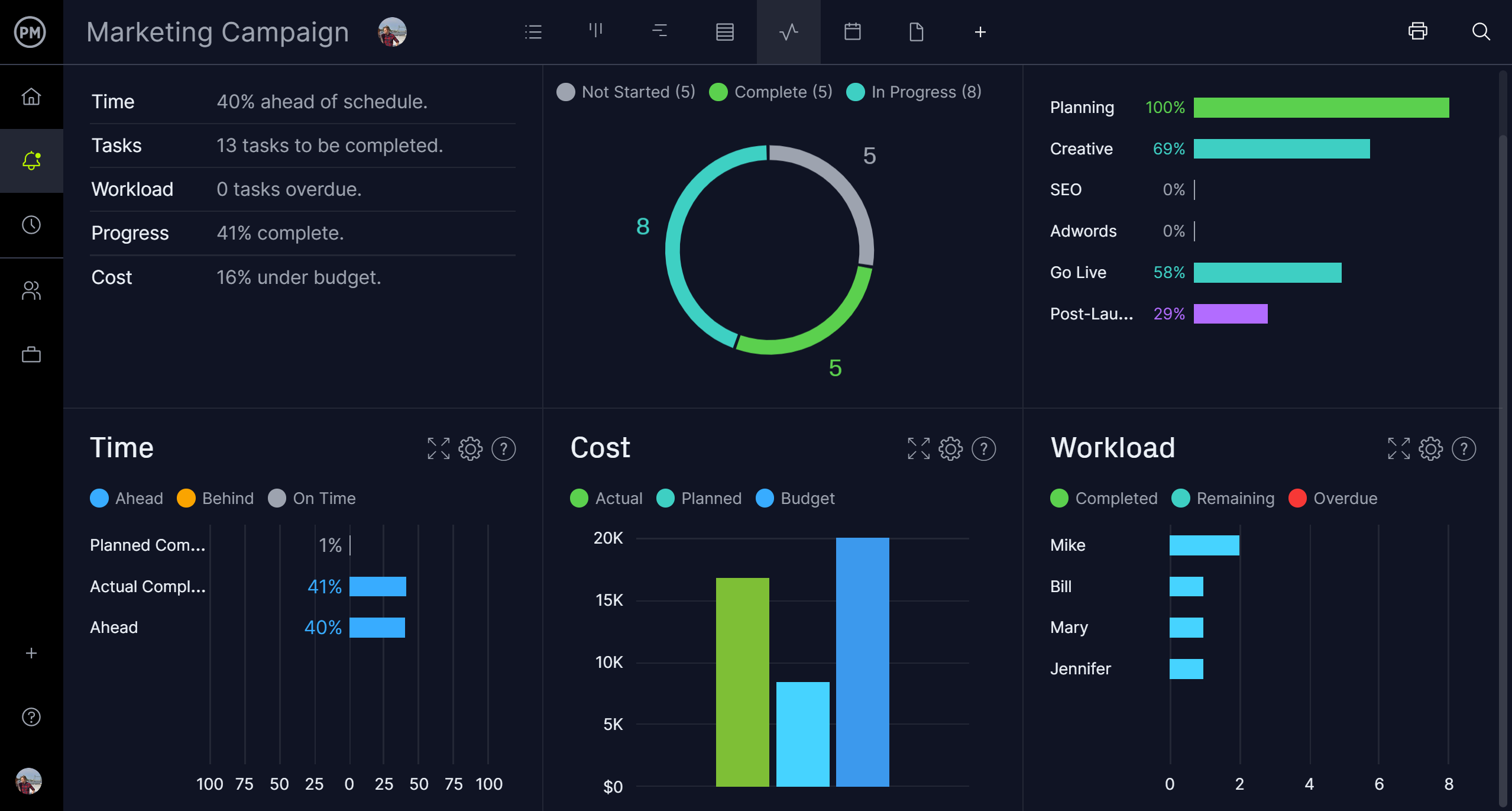
For more in-depth data, we feature one-click reports that can be filtered to show just the data you’re looking for. Reports track project variance, workload and more. You’ll catch issues and resolve them quickly before they become problems that threaten to derail your project.
If you want that scope of work to be the beginning of a beautiful project, then try ProjectManager for free with our 30-day trial offer.
Video: Scope of Work Best Practices
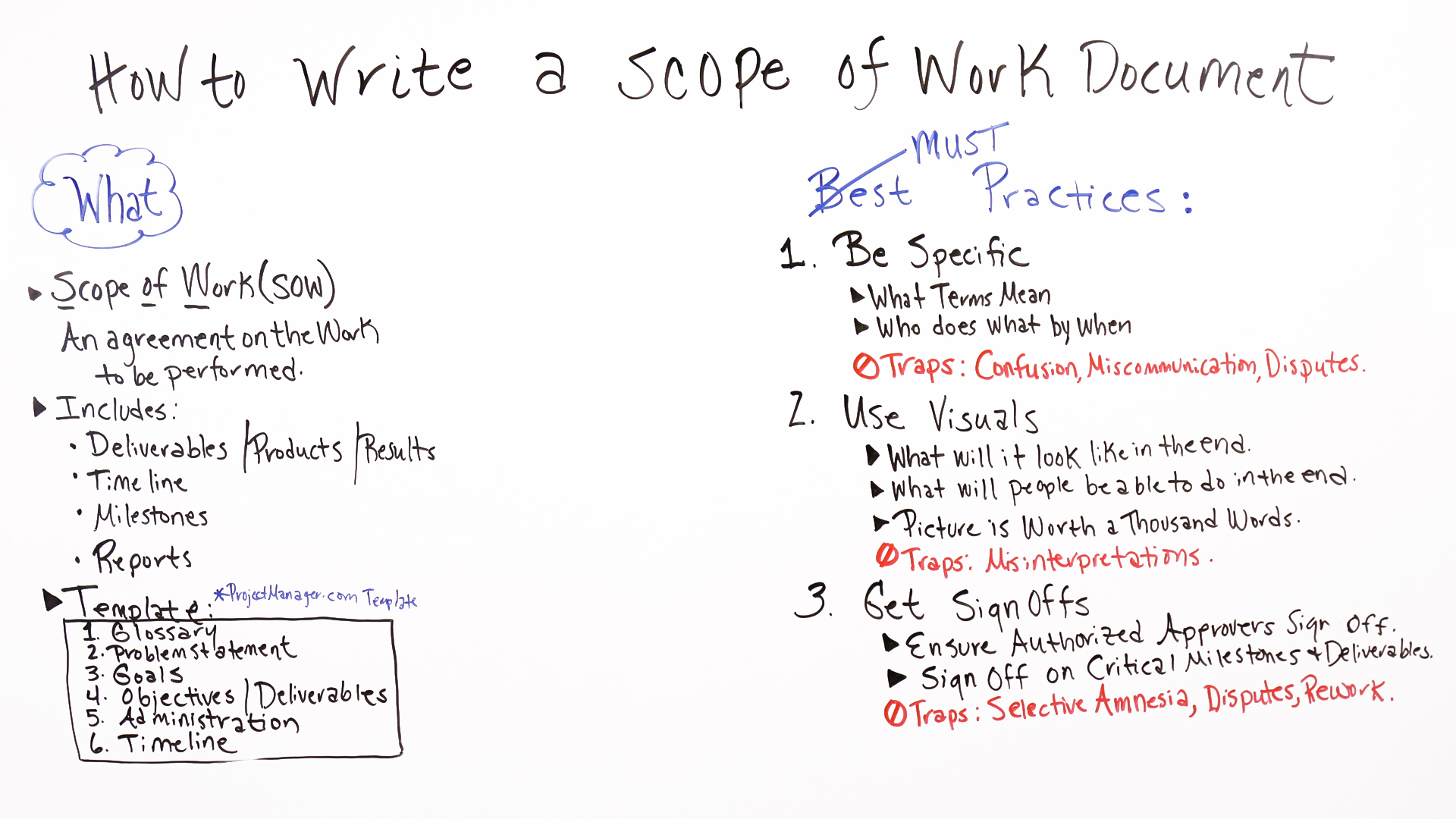
In this video, Jennifer Bridges, PMP, shows you how to write a scope of work for project management. Follow her steps to get started or use our project plan and scope document template!
Here’s a shot of the whiteboard for your reference!
Scope of Work Tips
But before you get to writing, you need to make sure you follow these tips.
- Be specific: explain the terms used clearly
- Use visuals: a picture is worth a thousand words
- Get sign-offs: make sure everyone who needs to okay the work, does
It’s not that difficult, but it needs to be thorough because you don’t want to have to play catch-up with paperwork when you’re in the heat of the project.
Pro tip: The SOW is essential to the project plan and is often included as part of the overall project plan, but it can be time-consuming to write. We’ve created dozens of project management templates to help you create all your project documents.
Related Project Planning Content
- Project Documentation: 15 Essential Project Documents
- How to Create a Project Execution Plan (PEP)
- How to Write a Scope of Work
- How to Write an Action Plan (Example Included)
- Alcance del Trabajo: ¿Cómo Escribir este Documento?
- Comment rédiger une portée des travaux (avec exemples et modèles inclus)
- Leistungsumfang erstellen – mit Beispielen und Vorlagen
- Como elaborar um escopo do trabalho
If you need a tool that can help you manage and track your scope of work document, then sign up for our software now at ProjectManager.
